How External Hazards Are Addressed in Nuclear Plants
This page provides the "big picture" of how the nuclear industry addresses external hazards — from initial site selection through periodic reassessment. It is the recommended starting point for readers who are new to external hazard assessment.
Overview
External hazard assessment in the nuclear industry draws on multiple technical disciplines, industry guidance, and operational considerations. The process is designed to ensure that nuclear power plants can withstand credible external events with adequate margins, and that these margins remain sufficient as understanding of hazards evolves over time.
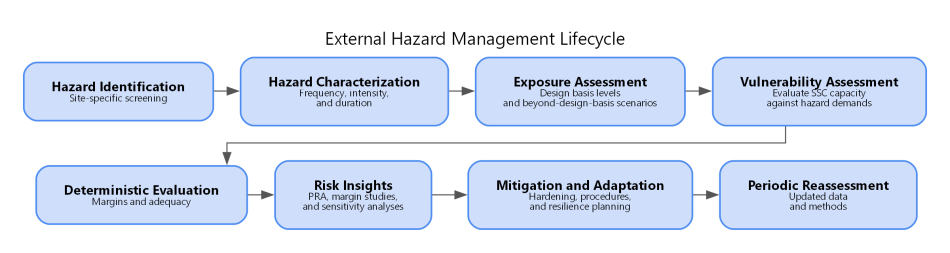
The figure below illustrates the major stages of this process. Each stage builds on the preceding one. As new data, methods, and operating experience become available, periodic reassessment helps ensure that plant evaluations reflect the current state of knowledge.
Site Selection and Siting Considerations
The external hazard management process begins before a plant is built. During the siting phase, candidate locations are evaluated against a range of natural and man-made hazards. Site characteristics such as proximity to floodplains, seismically active faults, coastal exposure, and nearby industrial facilities directly influence both the design basis and the risk profile of the facility.
Siting evaluations consider historical hazard data and regional geology and meteorology. Although siting decisions for the existing fleet were made decades ago, the principles remain relevant for new builds, small modular reactors, and advanced reactor designs.
Hazard Identification
Hazard identification is the process of systematically cataloging all external events that could potentially affect a nuclear plant site. This includes natural hazards (such as earthquakes, flooding, high winds, extreme temperatures, and wildfires) as well as human-induced hazards (such as aircraft impact, nearby industrial accidents, and transportation incidents).
The objective is to establish a comprehensive inventory of hazards before any are screened, prioritized, or analyzed in detail. The industry screening framework [3002005287 Identification of External Hazards for Analysis in Probabilistic Risk Assessment] catalogs approximately 68 external hazards (seismic excluded) and provides both qualitative and quantitative criteria for determining which hazards warrant further characterization and assessment. For more on this process, see Screening and Prioritization.
Hazard Characterization
Once hazards are identified, each is characterized in terms of its likelihood and severity. Hazard characterization provides the quantitative inputs needed for design basis development and risk assessment.
For many hazards, characterization involves constructing hazard curves that relate the severity of an event (such as wind speed, flood elevation, or peak ground acceleration) to its annual frequency of exceedance. These curves incorporate historical data, physical models, and expert judgment, and they form the technical basis for subsequent plant evaluations.
Exposure Assessment
Exposure assessment identifies which plant structures, systems, and components (SSCs) are affected by a given hazard and determines the hazard demands they must withstand. This step draws on hazard characterization results, site layout, SSC locations, and installed protective features to establish which components are exposed and at what severity levels. The resulting demand-to-SSC mapping provides the basis for subsequent evaluations.
In the United States, the design basis for each external hazard and the minimum performance requirements for safety-related SSCs are established through the plant's licensing basis under NRC regulations. Exposure assessment is informed by that regulatory framework, accepted industry methods, and site-specific walkdown data that document as-built conditions and potential flood pathways, missile populations, or other hazard-specific exposure mechanisms.
Vulnerability Assessment
Vulnerability assessment evaluates the capacity of plant SSCs against the hazard demands identified during exposure assessment. The objective is to determine whether plant structures, equipment, and systems can perform their intended safety functions under the expected hazard conditions.
Deterministic Evaluation
Deterministic evaluation is the traditional foundation of external hazard assessment for nuclear plants. In a deterministic framework, plant SSCs are evaluated against defined hazard levels (typically the design basis) to confirm that safety functions are maintained with adequate margins.
Deterministic methods include structural capacity calculations, margin assessments, and bounding analyses. These evaluations demonstrate that the plant can withstand the design basis hazard without loss of safety function. For many external hazards, deterministic evaluation remains the primary basis for licensing and regulatory compliance.
Risk Insights
Probabilistic risk assessment (PRA) complements deterministic evaluation by quantifying the likelihood and consequences of hazard scenarios, including those that might exceed the design basis. External events PRA integrates hazard curves, fragility models, plant response models, and consequence analysis to estimate risk metrics such as core damage frequency (CDF) and large early release frequency (LERF).
PRA builds upon (does not replace) the deterministic foundation. Risk insights from PRA can identify vulnerabilities not apparent in deterministic evaluations, prioritize plant improvements, and inform decision-making. For more detail, see Probabilistic Risk Assessment.
Mitigation and Adaptation
When assessment identifies potential vulnerabilities, the plant implements mitigation strategies to reduce risk. These strategies might include physical hardening of structures, installation of backup equipment, development of severe weather procedures, or deployment of portable mitigation equipment under programs such as FLEX.
Periodic Reassessment
Hazard characterizations can change as new data become available, as analytical methods improve, and as evolving climatic conditions alter the frequency or intensity of certain events. Periodic reassessment ensures that the plant's hazard evaluations remain current and that safety margins remain adequate over the facility's operating life.
Reassessment activities might include updating hazard curves with new observational data, incorporating improved climate projections, re-evaluating fragility estimates based on plant modifications, or performing focused studies on emerging hazard types.
Key References
| Year | Report Number | Title | Summary |
|---|---|---|---|
| 2015 | 3002005287 | Identification of External Hazards for Analysis in Probabilistic Risk Assessment | Industry-wide screening framework cataloging approximately 68 external hazards (seismic excluded) with qualitative and quantitative screening criteria. |
EPRI technical point of contact: Chris Rochon (CRochon@epri.com)
Date last reviewed: 2026-06-01