Methods/Screening and Prioritization
Screening and Prioritization of External Hazards
| Quick Reference | |
| Applicable hazards | All external hazards (excl. seismic, internal fire) |
| Team | PRA analyst, meteorologist/hydrologist, external hazard specialist |
| Primary input | Comprehensive hazard catalog + site characterization data |
| Primary output | Retained hazard list + screening documentation |
| Key guidance | EPRI 3002005287 |
Overview
External hazard screening is the systematic process of identifying which of approximately 68 potential external hazards are credible threats to a nuclear power plant site and which require further analysis. It is not an analytical method in itself but rather a structured decision process that precedes and scopes the methods described elsewhere in this section. The EPRI screening framework [3002005287] starts with a broad catalog of hazards. Sites should verify that this catalog adequately reflects their specific geographic, meteorological, and industrial setting, adding any site-specific hazard phenomena not captured by the generic categories. The framework then applies qualitative and quantitative criteria and explicitly addresses combined (multi‑hazard) events.
Performing detailed PRA for every conceivable hazard would be impractical — the catalog includes on the order of 50 natural, 12 man-made, and 6 other categories. Screening provides a systematic way to focus analytical resources on the hazards that matter most. The need for robust screening was reinforced by lessons from the 2011 Fukushima Daiichi accident and by the IPEEE Program (Generic Letter 88‑20, NUREG‑1407).
This sets the stage for a graded approach to hazard assessent, whereby hazards of increasing severity and potential plant impact are assessed in an increasingly more detail manner.
High‑Level Workflow
The screening process proceeds through progressive filtering, beginning with a comprehensive hazard list and ending with a short list of hazards requiring detailed analysis.
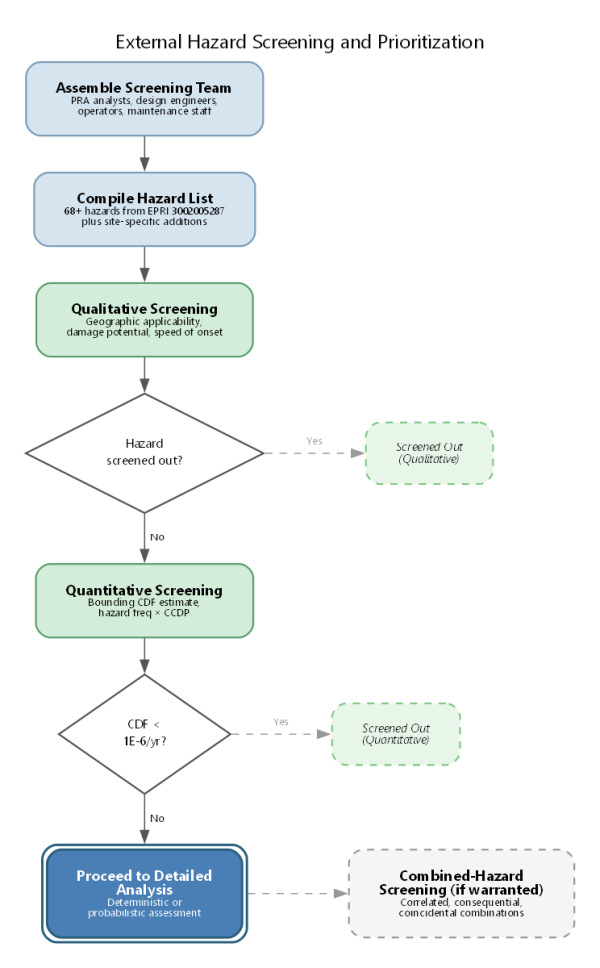
Color key: blue = characterization, green = analysis, dark filled = endpoint, diamond = decision point, gray dashed = supplemental, light dashed = off‑ramp.
Note: The "CDF < 10−6/yr" quantitative screening threshold shown in the flowchart is defined in [EPRI 3002005287]. An alternative formulation is also acceptable: hazard frequency < 10−5/yr and conditional core damage probability (CCDP) < 0.1, which conservatively bounds the same 10−6/yr CDF contribution.
Key Inputs and Outputs
| Category | Description |
|---|---|
| Inputs | |
| Comprehensive hazard catalog | Starting list of 68+ potential external hazards from EPRI 3002005287, supplemented by site‑specific geographic, meteorological, and industrial data. |
| Site characterization data | Geographic setting, proximity to rivers/coasts/dams/industrial facilities, historical event records, climatological data. |
| Plant design basis documents | Final Safety Analysis Report (FSAR), design‑basis event parameters, Standard Review Plan commitments. |
| Existing PRA model | Baseline internal‑events PRA for quantitative screening, including dominant accident sequences and success criteria. |
| Outputs | |
| Screened‑out hazard list | Hazards eliminated with documented basis (qualitative or quantitative criterion met). The documentation of screening justifications is a key and sometimes overlooked output. |
| Retained hazard list | Hazards requiring detailed deterministic or probabilistic analysis. |
| Screening documentation | Complete record of the team, data sources, criteria applied, and decisions made — essential for PRA peer review and regulatory audit. |
Screening Criteria
Qualitative Criteria
A hazard may be screened out qualitatively if any of the following conditions is met:
- The hazard cannot occur at the site (geographic impossibility — for example, tsunami at a continental interior site).
- The hazard develops sufficiently slowly that protective actions can be completed with high confidence before plant effects occur.
- The hazard's maximum credible intensity is bounded by another hazard for which the plant is already designed (for example, tornado winds bounded by the design‑basis tornado).
- The hazard cannot produce damage to any structures, systems, and components (SSC) relied upon for safe shutdown, even at maximum credible intensity.
Quantitative Criteria
If qualitative screening cannot eliminate a hazard, a bounding or conservative quantitative analysis may be performed:
| Criterion | Threshold | Basis |
|---|---|---|
| Core damage frequency (CDF) contribution | < 10−6 / year | Hazard‑specific CDF is negligible relative to the total plant CDF |
| Hazard frequency × CCDP | Frequency < 10−5/yr and CCDP < 0.1 | Conservative proxy: even assuming 10% conditional core damage probability, the CDF contribution is below 10−6/yr |
| Cliff‑edge adjustment | Lower threshold if hazard involves potential for sudden, large consequence increases near a physical or design margin | Prevents premature screening of hazards with threshold‑type failure modes |
These quantitative screening values were benchmarked against the risk profiles of the current LWR fleet (circa 2015) and may require adjustment for Gen III+, SMR, or advanced reactor designs [3002005287].
Hazards that survive individual screening are also evaluated for combined‑hazard interactions. For details on how correlated, consequential, and coincidental multi‑hazard scenarios are assessed, see Compound and Cascading Hazards.
| Re‑screening Triggers |
|---|
|
Strengths and Limitations
| Strengths | Limitations |
|---|---|
|
Existing widely-used approaches such as 3002005287 focus on:
Forward-looking climate vulnerability approaches work toward reducing these limitations. |
Related Methods and Processes
| Method / Process | Relationship to Screening |
|---|---|
| External Events PRA | Detailed quantitative risk assessment for hazards that cannot be screened out. Screening defines the scope of the PRA. |
| Walkdowns & Field Verification | Physical plant inspections that follow screening to confirm exposure and collect input data for detailed analysis. |
| Deterministic Approaches | For some hazards that screen in, a deterministic resolution path (such as design‑basis evaluation, TMRE) may suffice without proceeding to full PRA. |
| New Information Monitoring | Annual surveillance of hazard data that may trigger re‑screening if new information changes a hazard's frequency or intensity profile. |
| Combined‑Hazard Assessment | Multi‑hazard evaluation that directly builds on the combined‑hazard screening step described above. |
Key References
| Key References — use [▶ Show references] to expand | |||
|---|---|---|---|
| Year | Report Number | Title | Summary |
| 2021 | SSG‑68 | Design of Nuclear Installations Against External Events Excluding Earthquakes | International Atomic Energy Agency (IAEA) Safety Guide establishing requirements for design against external events; includes hazard identification and screening as prerequisite steps. |
| 2015 | 3002005287 | Identification of External Hazards for Analysis in Probabilistic Risk Assessment | Primary screening guidance. Catalogs 68 hazards, defines qualitative and quantitative screening criteria, and addresses combined‑hazard screening. Incorporates pilot feedback from five nuclear plant sites. |
| 2003 | IAEA‑TECDOC‑1341 | Extreme External Events in the Design and Assessment of Nuclear Power Plants | International perspectives on external hazard screening and design, including three‑class External Event Classification system. |
| 1991 | NUREG‑1407 | Procedural and Submittal Guidance for the Individual Plant Examination of External Events (IPEEE) for Severe Accident Vulnerabilities | NRC guidance that established the original U.S. framework for systematic external‑events screening at operating plants. |
Return to Methods and Tools.
EPRI technical point of contact: Chris Rochon (CRochon@epri.com)
Date last reviewed: 2026-05-21