Hazards/High Winds
High‑Wind External Hazards
Hazard Description
Tornadoes, hurricanes, straight‑line winds, and severe thunderstorms generate pressure loads on plant structures, propel loose objects as potential missiles, and produce rapid atmospheric‑pressure differentials between the interior and exterior of buildings. These effects can act on multiple plant features, from the containment shell and auxiliary buildings to switchyard components and offsite transmission infrastructure. Because high‑wind events vary widely in intensity, duration, and geographic reach, their assessment typically involves site‑specific climatological data, structural capacity evaluation, and, where warranted, integration with probabilistic risk models.
In the United States, the Standard Review Plan addresses high‑wind loading (SRP 3.3.1) and missile protection (SRP 3.5.1.4); internationally, standards such as IAEA SSG‑68 provide comparable design and assessment frameworks. Operational events, including Hurricane Andrew's impact on Turkey Point (1992) and tornado strikes at Browns Ferry, have informed successive updates to wind hazard assessment methods and plant protection strategies.
Mechanisms and Effects
| Mechanism | Physical Process | Representative Plant Effects |
|---|---|---|
| Direct wind loading | Wind velocity pressure on buildings, towers, and containment (SRP 3.3.1) | Structural demand on auxiliary building walls, roofs, and equipment enclosures; design adequacy assessed against code‑specified wind loads |
| Wind‑borne missiles | Equipment, debris, and other loose objects accelerated by tornado or hurricane winds to damaging velocities | Potential impact damage to concrete panels, barriers, piping, vent stacks, and tanks; fragility parameters for representative targets are tabulated in 3002015994 |
| Atmospheric pressure change (APC) | Rapid differential pressure between building interior and exterior during tornado passage | Differential pressure demand on walls, roofs, and penetration seals; design basis typically specifies a maximum APC rate |
| Offsite‑power vulnerability | Wind damage to transmission lines, switchyards, and transformers | Extended loss of offsite power (LOOP); probability and duration of LOOP increase with wind speed 3002018232 |
| Secondary / concurrent effects | Wind‑driven rain infiltration; wind‑induced storm‑surge flooding | Equipment wetting and combined‑hazard considerations; see also Hazards/External Flooding and Hazards/Compound and Cascading Hazards |
Assessment Approach
High‑wind hazard assessment follows a structured workflow that progresses through hazard characterization, exposure assessment, and vulnerability evaluation. Deterministic evaluation is the main‑line path; detailed assessment (fragility modeling, missile strike probability, and plant response modeling) is pursued when deterministic margins are insufficient. The simplified diagram below illustrates the major stages and their dependencies.
The assessment stages and example methods presented below represent a summary of the most prevalent known approaches at the time of writing. They are not intended to be exhaustive or representative of all possible site-specific situations, regulatory frameworks, or analytical strategies.
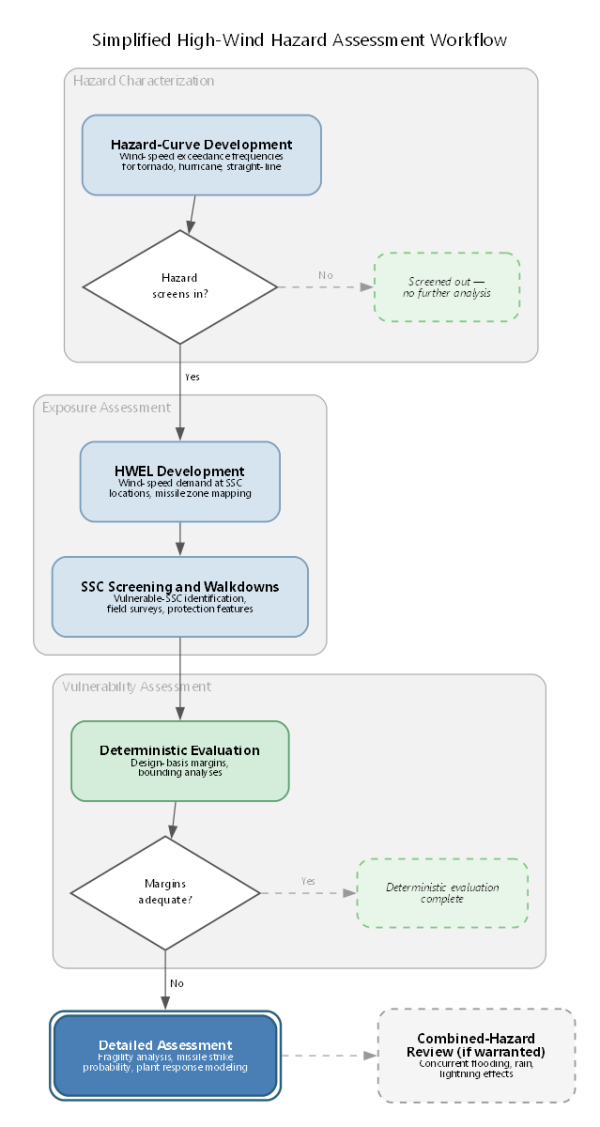
Simplified workflow. Color key: blue = characterization / exposure, green = analysis, dark filled = endpoint, gray dashed = supplemental (if warranted), diamond = decision point, dashed box = off‑ramp.
| Stage | Purpose | Example Methods / Tools |
|---|---|---|
| Hazard‑curve development | Produce wind‑speed exceedance‑frequency curves that serve as input to every downstream stage | Code‑based design wind speeds (ASCE/SEI 7); national/regional wind maps; tornado, hurricane, and straight‑line wind climatologies (SRP 3.5.1.4); site‑specific probabilistic hazard assessments for low‑AEP tails |
| HWEL development | Establish wind‑speed demand at SSC locations and map missile exposure zones | HWEL process 3002008092 |
| SSC screening and walkdowns | Identify vulnerable SSCs through field surveys, missile population inventories, and protection feature assessments | HWEL walkdown and vulnerability assessment guidance 3002008092 |
| Deterministic evaluation | Assess design‑basis margins and determine whether existing protections bound the hazard | Design‑basis review; TMRE NEI 17‑02 Rev 1; bounding analyses |
| Detailed assessment | Develop fragility functions, missile strike probabilities, and plant response models when deterministic margins are insufficient | Fragility analysis 3002015994; TMSC v2.0 3002029336; TORMIS; high‑wind PRA guidelines 3002003107 |
| Combined‑hazard review (if warranted) | Evaluate whether concurrent hazards (flooding, rain, lightning) should be considered | Compound and Cascading Hazards; combined hazard mitigation assessment 3002029338 |
Non-Stationary Climate Considerations
Future projections of how climatic conditions might affect extreme-wind hazards carry substantial uncertainty, particularly for convective phenomena such as tornadoes and severe thunderstorms. Existing projection modeling and data can provide qualitative insight for planning and monitoring. Periodic reassessment of site-specific wind hazard curves is a practical response to this uncertainty.
See also: Climate Vulnerability Assessment (CVA) · CHIP Climate Projections
Key References
| Key References — use [▶ Show references] to expand | |||
|---|---|---|---|
| Year | Report Number | Title | Summary |
| 2024 | 3002029336 | Tornado Missile Strike Calculator (TMSC) Version 2.0 | Spreadsheet tool computing conditional hit probability of tornado and high‑wind missiles at power plant sites. Results serve as inputs to high‑wind PRA quantification. |
| 2024 | IAEA‑TECDOC‑2043 | Evaluation of Design Robustness of Nuclear Installations Against External Hazards | IAEA guidance on evaluating design robustness against external hazards including wind loading and tornado effects; addresses margin assessment and cliff‑edge identification. |
| 2021 | 3002020906 | Consideration of Wind‑Driven Rain in High Winds Probabilistic Risk Assessment | Graded, four‑level approach for assessing wind‑driven rain effects in high‑wind PRAs, from bounding treatment through rainfall‑based fragility development. |
| 2020 | 3002018232 | High Wind Loss of Offsite Power Durations and Recovery | Operating‑experience‑based LOOP probability and recovery as a function of wind speed. Supports crediting offsite power recovery for wind speeds ≤ 165 mph. |
| 2019 | 3002015994 | Evaluation of Windborne Missile Fragilities for Piping, Vent Stacks, Liquid‑Filled Tanks, and Concrete Panels | Tabulated missile fragility parameters derived from nonlinear FE models and analytical methods, with probabilistic treatment of construction variability. |
| 2017 | NEI 17‑02 Rev 1 | Tornado Missile Risk Evaluator (TMRE) Industry Guidance Document | Deterministic screening of tornado‑missile protection; resolves nonconformances under EGM 15‑002 at 400–700 person‑hours per assessment. |
| 2017 | IAEA‑TECDOC‑1834 | Assessment of Vulnerabilities of Operating Nuclear Power Plants to Extreme External Events | IAEA methodology for assessing plant vulnerability to extreme wind events, including wind loading, tornado missile assessment, and SSC capacity evaluation. |
| 2016 | 3002008092 | Process for High Winds Walkdown and Vulnerability Assessments at Nuclear Power Plants | HWEL creation, vulnerability walkdowns, and site missile surveys. Includes three pilot‑walkdown results. |
| 2015 | 3002003107 | High‑Wind Risk Assessment Guidelines | Graded approach for high‑wind PRA: hazard analysis, SSC fragility analysis, and plant response model quantification. |
History of High‑Wind Regulation and Assessment
This section provides a chronological overview of the evolution of high‑wind hazard regulation and assessment for nuclear power plants. The timeline focuses on developments in the United States regulatory and standards context; other countries have pursued parallel evolutions in wind design and risk assessment.
| Year | Key Events or Publications |
|---|---|
| 1974 | Regulatory Guide (RG) 1.76 was issued in April 1974. As such, tornado protection requirements were considered in the original design of most United States (US) nuclear power plants (NPPs). Plants built before 1974 may not have committed to the regulatory updates. |
| 1974 - 1983 | Utilities found it difficult to conform to the RG 1.76 tornado missile protection licensing requirements, and various cases of nonconforming systems, structures, or components (SSCs) were identified, causing administrative burden on the utilities to track nonconformances. |
| 1983 | The US Nuclear Regulatory Commission (NRC) authorized the use of probabilistic risk (or safety) analysis (PRA or PSA) to demonstrate the acceptability of these nonconforming SSCs. That is, there would be no need to protect nonconforming SSCs if the change in risk associated with design features to protect against tornado missile impact is low enough - that is, a core damage frequency less than 10-6 per year (ΔCDF < 10-6/yr.).
The US NRC then validated the use of the TORMIS analysis code (EPRI NP-768, which was developed earlier, in 1978) to perform these probabilistic justifications through a Safety Evaluation Report (SER) dated October 26, 1983 and staff position for use “in lieu of the deterministic methodology when assessing the need for positive tornado missile protection for specific safety-related plant features…” |
| 1986 | Initial publication of NUREG/CR-4461 - Tornado Climatology of the Contiguous United States. This report estimates tornado strike probabilities and maximum wind speeds for use in nuclear power plant design based on characteristics of tornados reported since 1950. |
| 1988 | The definition of design basis tornado was revised in March 1988 based on historic tornado data available at the time. Available from the NRC ADAMS site as ML20148L164 (a direct link is not available).
A probabilistic and stochastic computer simulation model to assess the risk of wind-induced damage to structures and facilities called WINRIS was published. Twisdale, Lawrence A. “Probability of Facility Damage From Extreme Wind Effects.” Journal of Structural Engineering (New York, N.Y.) 114, no. 10 (1988): 2190–2209 This model has been referenced as one way of meeting high wind requirements in the ASME/ANS Standard for Level 1 / Large Early Release Frequency Probabilistic Risk Assessment for Nuclear Power Plant Applications (RA-S - 2008(R2019)) through at least 2021. |
| 1993 | The definition of design basis tornado was revised again in April 1993. SECY 93-87 changed the design basis tornado criterion to a mean recurrence interval of 10-7 per year, replacing the previous criterion of 10-7 per year exceedance probability at the upper 90% confidence interval level. This effectively reduced the design basis wind speeds. |
| 1995 | A probabilistic methodology to assess the risk of wind-induced damage to structures and facilities based on the 1988 WINRIS model was published. Twisdale L.A., Vickery P.J. (1995) Extreme-Wind Risk Assessment. In: Sundararajan C. (eds) Probabilistic Structural Mechanics Handbook. Springer, Boston, MA. Like the 1988 Twisdale model, this method has been referenced as one way of meeting high wind requirements in the ASME/ANS Standard (RA-S - 2008(R2019)) through at least 2021. |
| 1996 | Information Notice (IN) 96-06 was issued to alert NPP licensees "to the potential for inoperability of tornado dampers because of either inadequacies in damper testing or deficiencies in damper design." |
| 2005 | Revision 1 to NUREG/CR-4461 was issued, updating the tornado database and adding a finite-structure correction (the "lifeline" term) that accounts for the variation of wind speeds along and across the tornado footprint. This revision replaced the earlier point-target model, which treated the plant as a dimensionless point, and generally increased calculated tornado strike probabilities. |
| 2007 | Revision 2 to NUREG/CR-4461 was published in February 2007, incorporating additional tornado database updates.
Revision 1 of RG 1.76 was issued in March 2007, based on the updated NUREG/CR-4461 Rev. 2 climatology. This revision reduced design-basis tornado wind speeds at most U.S. sites. The National Weather Service released the Enhanced Fujita scale (EF-scale) on February 1, 2007. https://www.weather.gov/oun/efscale Regulatory Issue Summaries (RIS) were issued by the NRC (in particular RIS 2008-14 and RIS 2015-06) to remind licensees of the need to provide adequate justification of their tornado protection. |
| 2010–2011 | The NRC expanded its definition of the extreme environmental wind load to include hurricanes. Regulatory Guide 1.221 was issued in October 2011, based on two supporting reports: * NUREG/CR-7005 (2011) estimated the magnitude of extreme wind gusts during hurricanes at an exceedance frequency of 10-7 per year. * NUREG/CR-7004 (2011) calculated velocities associated with several types of missiles generated by different hurricane wind speeds. |
| 2015 | Enforcement Guidance Memorandum 15-002, Enforcement Discretion for Tornado-Generated Missile Protection Noncompliance, resulted in some plants discovering that some Technical Specification (TS) -controlled SSCs did not comply with their tornado design basis. If the licensee determined the affected SSC was non-complying but functional, the condition could be addressed through the licensee corrective action program. On the other hand, if the SSC was non-functional, the EGM allowed plants to use compensatory measures when TS limiting conditions for operation (LCOs) could not be met within the TS spec time. |
| 2017 | The industry response to RIS 2015-06 is the Tornado Missile Risk Evaluator (TMRE) method / tool established by NEI in 2017, NEI 17-02. This method provides "(1) a deterministic element to establish the likelihood that a specific structure, system, or component (SSC) (or “target”) will be struck and damaged by tornado-generated missile; and (2) a probabilistic element to assess the impact of the missile damage on the core damage and large early release frequencies." Although a probabilistic element is included, the TMRE is intended only for deterministic applications, and is not for use in a baseline (or average maintenance) PRA model. The goal of the TMRE is for deterministic modeling and applications, such as resolving "low safety significant nonconforming conditions associated with tornado missile protection requirements of the licensing basis." |
| 2021 | As of 2021, many US plants were using the deterministic TMRE approach. The TORMIS tool is commonly used and approved for PRA applications; however, the industry has noted that many of its features and inputs are beyond what is necessary to support PRA applications and cause analysis and maintenance burden. |
| 2022 | EPRI released the Tornado Missile Strike Calculator (TMSC), a simplified alternative to TORMIS intended for PRA applications. The current version is TMSC v2.0 3002029336. |
Summary of Key Wind Load Standards History
(further details are available at ascelibrary.org)
| Year | Standard | Summary |
|---|---|---|
| 1972 | ANSI A58.1-1972 | First consensus wind load design criteria. |
| 1982 | ANSI A58.1-1982 | Major changes to the wind load design criteria. |
| 1996 | ASCE 7-95 | Major changes to the wind load design criteria. The basic wind speed averaging time is a 3-second gust instead of fastest-mile speed. |
| 2006 | ASCE/SEI 7-05 | NRC SRP-referenced wind load design criteria. This is the version referenced in NUREG-0800 SRP 3.3.2 Rev. 3 (2007). |
| 2010 | ASCE/SEI 7-10 | Expansion and reorganization of the wind load design criteria.
Addition of risk category-dependent wind maps, removal of wind importance factor, and revision of wind load factor. |
| 2022 | ASCE/SEI 7-22 | Addition of new tornado hazard maps and provisions for tornado design. These maps and provisions are not currently adopted by the NRC Standard Review Plan (NUREG-0800 SRP 3.3.2 Rev. 3). However, the most recent NRC periodic review of Reg. Guide 1.76 suggests potential future implementation. |
See also: High Winds — Industry Experience for operating experience, lessons learned, and key events related to high-wind hazards.
EPRI technical point of contact: Chris Rochon (CRochon@epri.com)
Date last reviewed: 2026-05-27