Hazards/External Flooding
External Flooding Hazard Wiki
Hazard Description
External flooding encompasses all water-related natural or human-influenced hazards originating outside the plant that can challenge nuclear power plant structures, systems, and components (SSCs) through inundation, hydrostatic and hydrodynamic loading, or water ingress. (Flooding from internal water sources such as system piping is addressed separately as part of an internal flood assessment.) Applicable flood mechanisms span a wide range: riverine flooding, local intense precipitation, coastal storm surge, tsunami, dam or levee failure, ice-induced flooding, seiche, sea level rise, groundwater ingress, and wind-driven rain intrusion. The significance of a given flood event to plant safety depends on characteristics such as warning time, rate of rise, peak water level, duration, flow velocity, wave and debris loading, and whether concurrent hazards accompany the flood.
External flooding has figured prominently in nuclear operating experience and regulatory development. The 2011 Fukushima Daiichi accident, in which tsunami-induced flooding contributed to station blackout and core damage at three units, prompted worldwide reassessment of flood protection and mitigation strategies. In the U.S., riverine floods at Fort Calhoun (2011) and Cooper Nuclear Station (2019) led to extended flood response actions [ML22222A111] [PNO-IV-19-001]. The regulatory and standards framework that has evolved from this experience is broad, encompassing NUREG-0800 (SRP 2.4.1–2.4.12), Regulatory Guide 1.59, the post-Fukushima 50.54(f) information request [ML12053A340], and the ASME/ANS PRA Standard (RA-S-1.1–2024). Regional climate projections in some areas indicate trends toward increased precipitation intensity, rising sea levels, and shifting storm patterns, which underscores the value of periodic reassessment of site-specific flood hazard characterizations [3002029339 Site-Specific Climate Hazard Information and Projections: Technical Summary].
Mechanisms and Effects
| Mechanism | How It Affects the Plant |
|---|---|
| Riverine flooding | Overflow from rivers and streams can inundate SSCs. Design-basis assessments use the Probable Maximum Flood framework (SRP 2.4.3; SSG‑18). |
| Local intense precipitation (LIP) | Rapid on-site rainfall accumulation exceeds drainage capacity, ponding against buildings and potentially entering through doors, hatches, and conduit penetrations. Often a key non-riverine mechanism at inland sites. |
| Coastal flooding and storm surge | Hurricane or extratropical storms drive water levels well above normal tide, inundating shoreline equipment and intake structures. Assessed using the Probable Maximum Hurricane / Probable Maximum Wind Storm framework (SRP 2.4.5; SSG‑18). |
| Tsunami | Long-period ocean waves generated by sub-marine earthquakes, volcanic eruptions, or landslides arrive with little warning and can overwhelm coastal defenses. The Fukushima Daiichi accident is the seminal example (SRP 2.4.6). |
| Dam and levee failure | Breach of upstream water-control structures due to overtopping, seismic loading, or piping produces rapidly rising flood waves that can arrive with little warning (SRP 2.4.4; SSG‑18). |
| Ice-induced flooding | Ice jams or frazil ice obstruct waterways, causing upstream impoundment and sudden downstream release (SRP 2.4.7; SSG‑18). |
| Sea level rise | Long-term increase in mean sea level amplifies the baseline for all coastal flood mechanisms, shifting exceedance curves toward higher inundation levels and adjusting boundary conditions for coastal hazard assessments [3002032030] (SSG‑18). |
| Groundwater ingress | Elevated groundwater from sustained precipitation or regional water-table changes can undermine foundations or flood below-grade rooms and tunnels (SRP 2.4.12; SSG‑18). |
| Wind-driven rain intrusion | Rain forced through openings or breached cladding during concurrent high-wind events wets electrical and I&C equipment inside structures [3002020906] (SSG‑18). |
| Seiche | Oscillation of water in enclosed or semi-enclosed basins (lakes, harbors) driven by atmospheric pressure changes, wind, or seismic activity (SRP 2.4.5; SSG‑18). This phenomenon is capable of producing temporary increases in local water level. |
Assessment Approach
External flood risk assessment follows a structured progression from hazard identification through integrated evaluation. Deterministic approaches (for example, probable maximum event type approaches) remain the foundation of many plant licensing bases; probabilistic flood hazard assessment (PFHA) is increasingly used for risk-informed applications and for hazards that exceed the design basis. The EPRI External Flooding Guidance [3002023808] provides the comprehensive XFPRA framework integrating hazard characterization, fragility modeling, and plant response analysis.
The assessment stages and example methods presented below represent a summary of the most prevalent known approaches at the time of writing. They are not intended to be exhaustive or representative of all possible site-specific situations, regulatory frameworks, or analytical strategies.
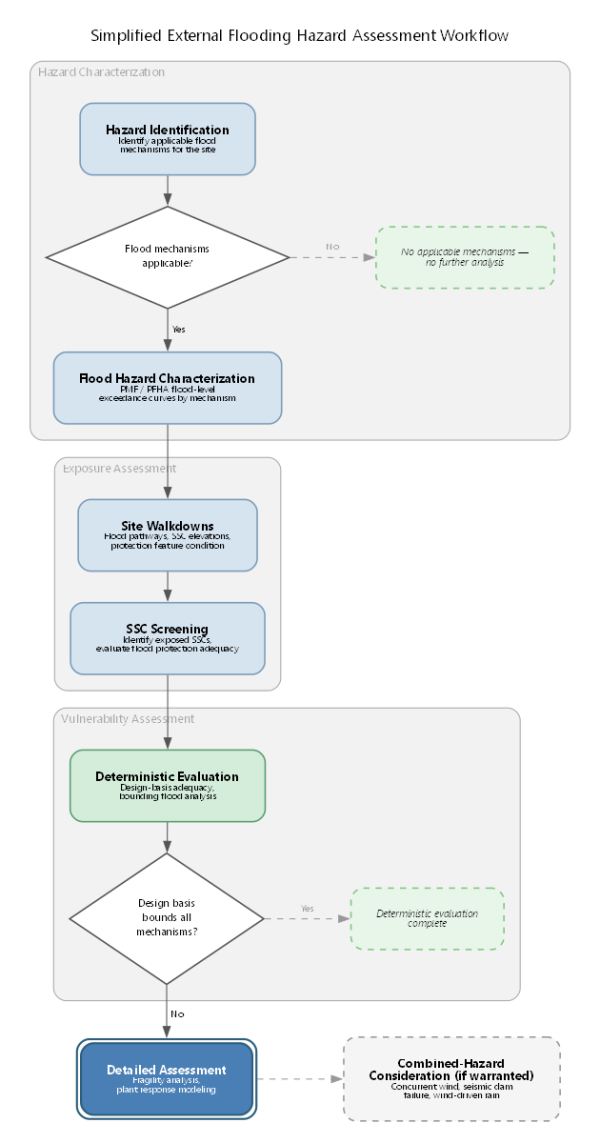
Simplified workflow. Color key: blue = characterization / exposure, green = analysis, dark filled = endpoint, gray dashed = supplemental (if warranted), diamond = decision point, dashed box = off‑ramp. The diagram is illustrative and not prescriptive; individual country/regulator frameworks may structure steps differently.
| Stage | Purpose | Example Methods / Tools |
|---|---|---|
| Hazard identification and screening | Determine which flood mechanisms are applicable to the site | External hazard identification process [3002005287] |
| Flood hazard characterization | Develop flood-level exceedance-frequency curves for each applicable mechanism | PMF / PFHA methods; SHAC-F (LIP, riverine, coastal); JPM (storm surge); SEFM / RORB_MC (riverine); SST (LIP) [3002023808] |
| Site walkdowns | Document flood pathways, SSC elevations, and protection feature condition; Maintain flood barriers consistent with design and licensing basis | XFPRA walkdown guidance [3002015989] |
| SSC screening | Identify exposed SSCs and evaluate flood protection adequacy to determine which components require further analysis | XFPRA walkdown guidance [3002015989]; flood protection systems assessment [3002005423] |
| Deterministic evaluation | Assess design-basis adequacy and determine whether existing flood protections bound all applicable mechanisms | Design-basis review; PMF/PMH bounding analyses; evaluation of deterministic approaches [3002008113] |
| Detailed assessment | Develop fragility functions, plant response models, and integrated risk quantification when deterministic margins are insufficient | Fragility and flood protection analysis [3002005423]; [XFPRA (3002023808)]; NEI 16-05 graded approach [NEI 16-05] |
| Combined-hazard consideration | Evaluate concurrent, correlated, and/or interdependent hazards such as wind + surge, seismic dam failure, or wind-driven rain | Combined hazard mitigation assessment [3002029338] |
Non-Stationary Climate Considerations
Evolving precipitation patterns, rising sea levels, and shifting storm tracks can each alter the frequency and severity of the flood mechanisms described above, making periodic reassessment of site-specific flood hazard characterizations an important complement to historically-focused assessments. Translating broad climatic trends into quantitative flood parameters, however, remains analytically challenging. Precipitation modeling at the local scale, particularly for the short-duration, high-intensity rainfall that drives local intense precipitation (LIP) hazards, is an area of active research, and the secondary process models required for site-specific flood analyses (PMP, PMF, LIP return periods) represent significant technical undertakings in their own right. EPRI-led CVAs addressed flood hazards using a graded approach in which existing site-specific flood analyses provided the initial screening basis, and climate projection data from the Climate Hazard Information and Projections (CHIP) program focused on qualitative trends.
For coastal sites, even modest sea level rise can amplify wave-driven flooding. Rising sea levels reduce the effectiveness of natural coastal barriers (offshore islands, reefs, and shallow nearshore bathymetry), increasing wave setup and the spatial extent of wave energy reaching plant structures. EPRI research found that wave-driven components such as setup amplify as natural sheltering diminishes, meaning that even moderate sea level rise can materially expand the coastal flood hazard footprint [3002032030].
See also: Climate Vulnerability Assessment (CVA) · CHIP Climate Projections
Key References
| Key References — use [▶ Show references] to expand | |||
|---|---|---|---|
| Year | Report Number | Title | Summary |
| 2026 | NUREG/CR-7292 | Structured Hazard Assessment Committee Process for Flooding (SHAC-F) | NRC-developed framework (adapted from SSHAC) for performing probabilistic flood hazard assessments for LIP, riverine, and coastal flooding. |
| 2025 | 3002032030 | Impact of Sea Level Rise on Coastal Flooding Hazard | Assessment of sea level rise effects on total water levels at coastal nuclear facilities, based primarily on a pilot site study. |
| 2024 | RG 1.59 (DG-1290) | Design-Basis Floods for Nuclear Power Plants | Draft revision of RG 1.59 providing updated acceptable methods for determining design-basis floods, incorporating post-Fukushima lessons. |
| 2024 | ASME/ANS RA-S-1.1–2024 | Standard for Level 1/LERF PRA for Nuclear Power Plant Applications | PRA standard with dedicated technical requirements for external flood PRA, including hazard analysis, fragility, and plant response modeling. |
| 2024 | 3002029338 | A Method for Assessing Mitigation of Combined External Hazards | Methodology for assessing plant mitigation capabilities for combined external hazards that do not screen out using prior methods. |
| 2024 | IAEA‑TECDOC‑2043 | Evaluation of Design Robustness of Nuclear Installations Against External Hazards | IAEA guidance on evaluating design robustness against flooding hazards, including flood margin assessment, cliff‑edge effects, and lessons learned from Fukushima. |
| 2022 | 3002023808 | External Flooding Guidance for Probabilistic Risk Assessment | Comprehensive XFPRA guidance integrating hazard characterization, fragility modeling, plant preparatory actions, and combined-hazard treatment. |
| 2019 | 3002015989 | External Flooding Probabilistic Risk Assessment Walkdown Guidance | Systematic guidance for walkdowns supporting external flood PRA model development. |
| 2018 | 3002012996 | Probabilistic Flood Hazard Assessment Using the Joint Probability Method for Hurricane Storm Surge | JPM methodology for estimating hurricane storm surge exceedance probabilities using ADCIRC+SWAN. |
| 2017 | 3002010667 | Paleoflood Evidence of Past Flooding Events: Investigation into the Available Sources of Paleoflood Evidence in Humid Environments | Investigation of paleoflood evidence in humid environments to extend flood frequency estimates beyond the historical record, with field work along the Tennessee River and tributaries. |
| 2017 | 3002010620 | External Flood Protection Design/License Basis Management Best Practices Guide | Best practices for maintaining flood protection features consistent with the plant design and licensing basis. |
| 2017 | IAEA‑TECDOC‑1834 | Assessment of Vulnerabilities of Operating Nuclear Power Plants to Extreme External Events | IAEA methodology for assessing plant vulnerability to external flooding, including flood capacity assessment, walkdown practices, and risk estimation. |
| 2016 | 3002008113 | Evaluation of Deterministic Approaches to Characterizing Flood Hazards | Identifies opportunities to improve realism in deterministic flood hazard assessments while maintaining a conservative, bounding approach. |
| 2016 | 3002008111 | Probabilistic Flooding Hazard Assessment for Storm Surge | Methods for probabilistic storm surge hazard assessment, with application to the Great Lakes region using historical water level data and Monte Carlo simulation. |
| 2016 | NEI 16-05 Rev 0 | External Flooding Integrated Assessment Guidelines | Graded approach for assessing flood hazards exceeding the plant design basis; five paths from focused evaluation to full integrated assessment. |
| 2015 | 3002005423 | Flood Protection Systems Guide | Guidance on design, testing, inspection, and maintenance of flood protection components for NPPs. |
| 2015 | 3002005292 | External Flooding Hazard Analysis: State of Knowledge Assessment | Assesses deterministic and probabilistic methods for evaluating external flood risks and identifies research needs. |
| 2015 | 3002005287 | Identification of External Hazards for Analysis in Probabilistic Risk Assessment | Guidance on identifying and screening external hazards for PRA, including qualitative and quantitative screening criteria. |
| 2014 | 3002004400 | Local Precipitation-Frequency Studies | Probabilistic approaches to estimating extreme local rainfall at NPP sites, supporting LIP hazard characterization. |
| 2014 | 3002003013 | Riverine Probabilistic Flooding Hazard Analysis Pilot | Demonstrated feasibility of probabilistic flood hazard analysis using SEFM and RORB_MC. PMF elevation exceedance estimated at less than 10-6/year. |
| 2012 | ML12053A340 | Request for Information Pursuant to 10 CFR 50.54(f) | Post-Fukushima NRC request to all licensees for reevaluation of seismic and flooding hazards using present-day methods. |
| 2007 | NUREG-0800, Ch. 2.4 | Standard Review Plan — Hydrologic Engineering | SRP sections 2.4.1–2.4.12 covering the full range of hydrological hazards. |
History of External Flooding Regulation and Assessment
This section provides a chronological overview of the evolution of external flood hazard assessment for nuclear power plants.
| Year | Key Events or Publications |
|---|---|
| 1977 | Regulatory Guide 1.59 (Rev 2) was issued, updating design-basis flood criteria for nuclear power plants based on the Probable Maximum Event concept. Plants designed before the original issuance of this guidance may have varying flood design bases. |
| 1991 | NUREG-1407 was issued, providing guidance for the Individual Plant Examination of External Events (IPEEE). External flooding was assessed using a progressive screening approach, and approximately 80% of plants screened flooding hazards using Standard Review Plan criteria. |
| 1992 | Hurricane Andrew struck the Turkey Point Nuclear Generating Station (Category 4, sustained winds of 145 mph). Although primarily a wind event, the NRC/INPO lessons-learned report [NUREG-1474] highlighted the importance of pre-storm preparations and concurrent hazard effects (wind, surge, loss of offsite power (LOOP)) for coastal plants. |
| 1999 | A storm surge driven by high tides and severe winds flooded the Le Blayais Nuclear Power Plant in France, affecting Units 1 and 2. Water intrusion disabled essential service water pumps, flooded utility galleries, and impacted safety injection equipment. The event prompted significant enhancements to flood defenses at French and European nuclear sites. |
| 2011 | The Fukushima Daiichi accident (March 2011) involved tsunami-induced flooding that led to station blackout and core damage at three units. This event was the single most consequential external flooding event in nuclear history and triggered worldwide reassessments of flood hazard protection. |
| 2011 | Historic flooding on the Missouri River caused Cooper Nuclear Station to declare an Unusual Event and Fort Calhoun Station to enter an extended flood response lasting several months [ML22222A111]. Both events demonstrated the challenges of sustained riverine flooding at NPPs. |
| 2012 | The NRC issued a request for information pursuant to 10 CFR 50.54(f) [ML12053A340], requiring all power reactor licensees to reevaluate seismic and flooding hazards using present-day methods and regulatory guidance. This initiated a multi-year industry effort to characterize flood hazards and evaluate plant responses. |
| 2015 | NRC Information Notice 2015-01 [IN-2015-01] documented multiple instances of degraded flood protection features at U.S. plants, including failed penetration seals, inadequate flood barriers, and procedural deficiencies. |
| 2016 | NEI 16-05 [NEI 16-05] was issued, providing a graded approach for evaluating flood hazards that exceed the plant design basis, with five assessment paths ranging from focused evaluation to full integrated assessment. |
| 2019 | Cooper Nuclear Station declared an Unusual Event due to rising Missouri River levels [PNO-IV-19-001], demonstrating the ongoing relevance of riverine flood hazards to plant operations. |
| 2022 | EPRI published comprehensive external flooding guidance for probabilistic risk assessment [3002023808], integrating hazard analysis, fragility modeling, and plant response evaluation into a unified XFPRA framework. |
| 2024 | ASME/ANS published the updated PRA standard (RA-S-1.1–2024), which includes external flood PRA as a dedicated hazard group with specific technical requirements for hazard analysis, fragility, and plant response modeling. |
| 2024 | Draft Regulatory Guide 1.59 (DG-1290) was issued, updating acceptable methods for determining design-basis floods and incorporating post-Fukushima lessons learned. |
| 2026 | NUREG/CR-7292 established the SHAC-F process for performing probabilistic flood hazard assessments, adapting the Senior Seismic Hazard Analysis Committee (SSHAC) methodology to flooding. |
See also: External Flooding — Industry Experience for operating experience, lessons learned, and key events related to external flooding hazards.
EPRI technical point of contact:
Chris Rochon (CRochon@epri.com)
John Weglian (JWeglian@epri.com)
Date last reviewed: 2026-06-02